 EN
EN
The Price Tag Trick: What "Competitive Electric Forklift Prices" Actually Mean for Your Fleet
A purchasing manager comparing two electric forklift quotes — one at 18,000 and another at 22,000 — nearly always flags the cheaper option for approval. The logic is straightforward: the same lifting capacity, the same lift height, the same battery voltage — why pay $4,000 more for what appears to be the same machine? The answer hides in costs that the purchase order does not capture: energy consumption per shift, maintenance frequency, spare-parts availability, battery lifespan, and the downtime cost of waiting for service when the cheaper machine fails.
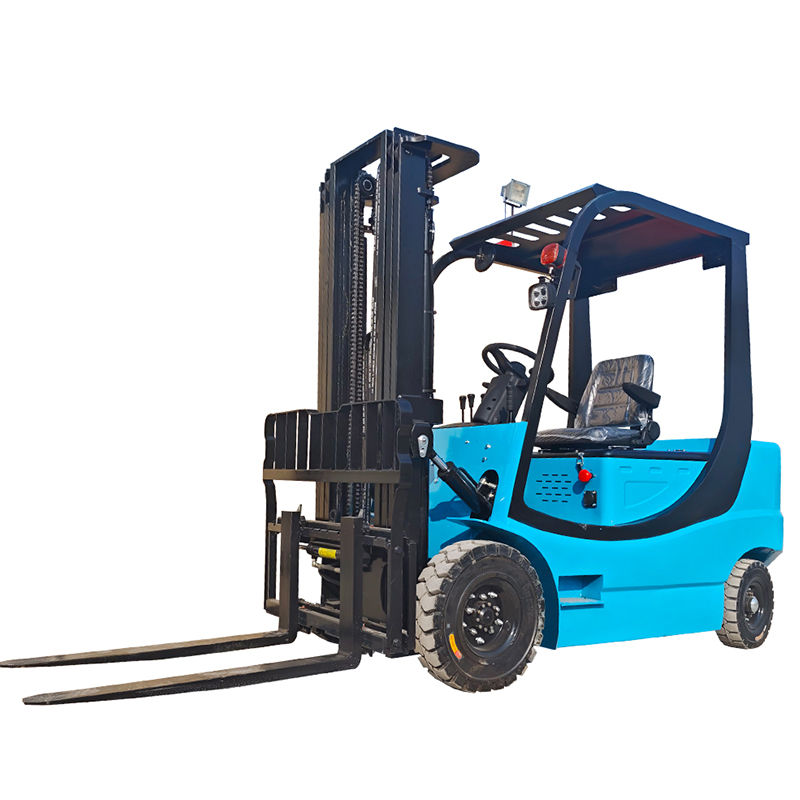
Competitive electric forklift prices must be evaluated against total cost of ownership (TCO), not purchase price. A forklift consuming 5 kWh per shift at 0.12/kWh costs 0.60 per day in electricity; at 250 operating days per year over a 7-year lifespan, that is 1,050 in total energy cost. A less efficient machine consuming 7 kWh per shift costs 1,470 over the same period — a 420 difference that partially offsets the initial price gap. Add in maintenance: a machine with sealed dual hydraulic cylinders and cast steel axles may need one major repair in 7 years; a machine with lower-spec components may need three, at 800–1,500 per repair. The 4,000 sticker-price gap shrinks rapidly.
Where Price Differences Come From
Factory-Direct vs. Distributor: The Markup Layers
Every intermediary between the manufacturer and the end customer adds a margin layer to the forklift price. A distributor network typically adds 15–25% markup to cover warehousing, sales commissions, and local inventory financing. Tiantong Machinery, operating its 20-acre production facility in Shandong with monthly production of 2,000 units and serving over 50 countries through 110+ cooperative agents, ships factory-direct — eliminating the distributor layer that would otherwise inflate the per-unit cost by thousands of dollars.
The factory-direct model also changes the parts equation. A distributor holding inventory in a regional warehouse charges a markup on every replacement part because they have capital tied up in shelf stock. A factory-direct manufacturer ships parts from production inventory at cost-plus-freight, typically saving 30–50% on commonly replaced components like tires, brake pads, and hydraulic seals over the equipment's service life.
Battery Chemistry: The Hidden TCO Driver
The single largest TCO variable between comparably priced electric forklifts is the battery system. A forklift equipped with a lead-acid battery costs 1,500–2,500 less at purchase than one with a lithium battery — but the lead-acid battery requires weekly watering, monthly equalization charging, specialist ventilation for hydrogen off-gassing, and replacement every 1,200–1,500 cycles. The lithium battery (such as the Chaowei units Tiantong Machinery offers as an upgrade option) requires no watering, no equalization, produces no hydrogen, and lasts 3,000–5,000 cycles. Over a 7-year single-shift operation, the lead-acid forklift will require two battery replacements at a combined cost that exceeds the lithium upgrade premium, plus the labor cost of weekly maintenance.
Real-World Application: A Fleet Buyer's TCO Wake-Up Call
A logistics company operating 12 forklifts across three warehouses requested quotes for fleet replacement. Two suppliers submitted bids: one at 17,500 per unit (lead-acid, distributor-sourced, 18-month parts coverage) and one at 20,500 per unit (lithium battery, factory-direct from Tiantong Machinery, 3-year drivetrain coverage, with CE and ISO 9001 certifications). The purchasing team recommended the lower bid.
The operations manager pushed back, requesting a 5-year TCO comparison. The analysis revealed: the lead-acid fleet would require battery replacement at year 3 (2,200 per unit × 12 = 26,400), weekly maintenance labor (15 per week per unit × 12 units × 260 weeks = 46,800), and higher energy consumption (lower motor efficiency, estimated 8,400 extra over 5 years). The TCO gap: the "cheaper" fleet actually cost 61,600 more over 5 years. The company purchased the factory-direct lithium fleet from Tiantong Machinery and recovered the higher initial investment within 22 months from reduced operating costs.
Frequently Asked Questions
What is a reasonable price for a 2-ton electric forklift?
A 2-ton electric forklift with a 60V system, 4,000W AC motor, and 4–8 hour runtime typically ranges from 15,000 to 25,000 depending on battery type (lead-acid vs. lithium), lift height customization, and whether the purchase is factory-direct or through a distributor. Tiantong Machinery's factory-direct pricing eliminates distributor markup while maintaining CE and ISO 9001 certified build quality.
How much cheaper is an electric forklift to operate than a diesel forklift?
Electric forklifts reduce per-shift energy costs by approximately 70% compared to diesel — from 20–30 per day in diesel to 0.60–1.50 per day in electricity. Maintenance costs are 60–80% lower due to the simpler drivetrain (no engine oil, fuel filters, exhaust system, or transmission fluid to service).
Should I buy lead-acid or lithium batteries for my fleet?
Lithium batteries cost more upfront (2,000–3,500 premium per unit) but last 3–5 times longer, charge faster, require zero maintenance, and maintain performance in cold environments. Lead-acid batteries are cheaper initially but require weekly watering, equalization charging, and replacement every 1,200–1,500 cycles. For multi-shift operations, lithium's opportunity-charging capability (recharging during breaks without battery damage) often justifies the premium on productivity gain alone.
How do I verify that a "factory-direct" forklift price is truly direct?
Request the manufacturer's ISO 9001 certificate and factory address. A genuine factory-direct supplier ships from its production facility, provides factory contact information for service and parts, and can supply production-line photographs or video of your specific units being assembled. Tiantong Machinery welcomes factory visits at its 20-acre Shandong production base.
What financing options are available for forklift fleet purchases?
Options include outright purchase (lowest total cost over the equipment's life), lease-to-own (lower upfront cash requirement, monthly payments over 3–5 years), and operating lease (no ownership, equipment returned at lease end). Tiantong Machinery's sales team can discuss pricing structures suitable for different fleet sizes and procurement models.
Does a higher purchase price mean better build quality?
Not always — but certain cost indicators correlate with durability: cast steel axles vs. fabricated steel, sealed hydraulic cylinders with name-brand seals vs. generic cylinders, forged forks vs. welded assemblies, and national-standard cable gauge (25 mm²) vs. thinner wiring. Tiantong Machinery's electric forklifts use Laigang steel mast material (20–30 mm thickness), cast steel front and rear axles, and genuine Tongheli hydraulic components — specifications that add manufacturing cost but extend service life.