
 EN
EN
Power Source Math: When a Warehouse Electric Forklift Pays Back the Premium
Electric forklifts carry a purchase premium of 15–30% over equivalent-capacity internal combustion models. Warehouse operators evaluating the transition need hard numbers, not environmental sentiment. The payback analysis centers on three measurable cost categories — energy, maintenance, and operational lifespan — where electric consistently outperforms gas and diesel on warehouse duty cycles.
Energy Cost Comparison
Electricity vs. Propane and Diesel: Per-Hour Operating Cost
An electric forklift in the 2–3 ton capacity class consumes approximately 5–8 kWh per operating hour at typical warehouse duty cycles. At average commercial electricity rates, this translates to 0.60–1.20 per hour. An equivalent LP gas forklift consumes 2.5–4.0 pounds of propane per hour at 1.20–1.80 per pound — 3.00–7.20 per operating hour. The per-hour energy cost differential of approximately 2.00–6.00 accumulates quickly: a warehouse operating two shifts (3,500 hours annually per truck) saves $7,000–21,000 per truck per year in energy cost alone.
Diesel forklifts used in indoor-outdoor warehouse environments consume 0.8–1.5 gallons per hour at 3.50–5.00 per gallon — 2.80–7.50 per hour in fuel cost. The electric forklift maintains its per-hour energy advantage across both propane and diesel comparisons, with the magnitude varying by local utility rates and fuel prices.
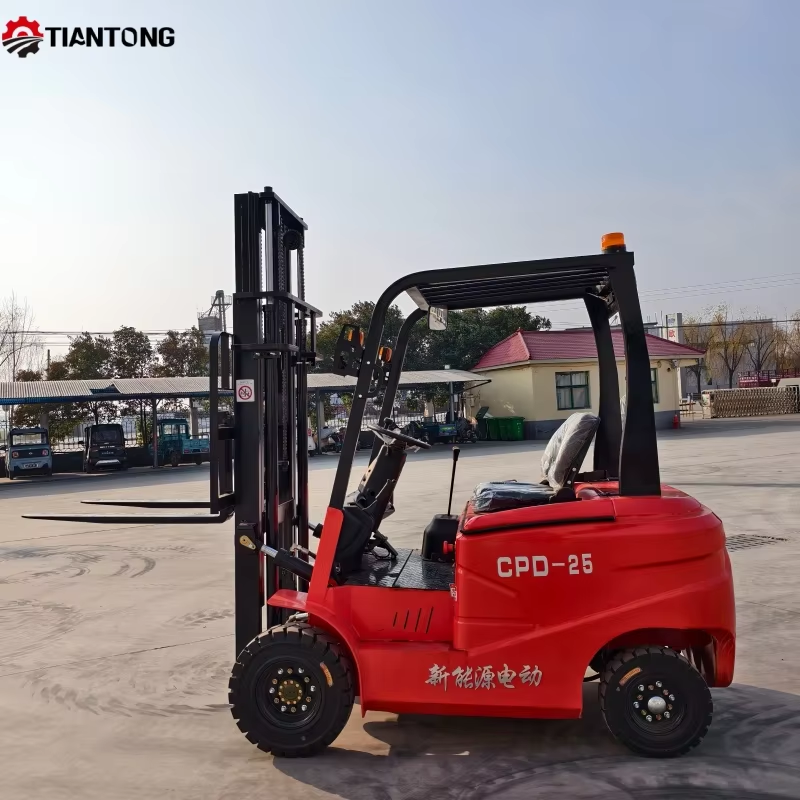
Jining Tiantong Machinery's 2-ton electric forklift — featuring 4000W dual AC drive motors and a 60V / 5×70Ah battery system delivering 4–8 hours of operation per charge — exemplifies the energy economics. At 6–7 hours of charging time on standard 220V infrastructure, a single overnight charge supports a full warehouse shift without the fuel-handling logistics that propane and diesel require.
Battery Replacement Cost in the ROI Timeline
The battery pack represents the electric forklift's largest single replacement cost — typically $3,000–6,000 for lead-acid batteries at replacement intervals of 1,200–1,500 charge cycles (3–5 years of single-shift operation). Lithium-iron-phosphate batteries extend replacement intervals to 2,500–3,500 cycles (7–10 years) at approximately double the upfront cost. When calculating five-year ROI, the battery replacement cost must be included — but even with one lead-acid battery replacement, the energy and maintenance savings over the same period typically exceed the combined purchase premium and battery replacement cost by year three or four.
Maintenance Savings
Why Electric Drivetrains Reduce Service Intervals
Internal combustion forklifts require oil changes every 200–250 hours, transmission fluid service, fuel filter replacement, spark plug and ignition system maintenance, coolant system service, and periodic exhaust-system inspection. These scheduled services consume 30–60 hours of downtime annually per truck. Electric forklifts eliminate all engine-related maintenance — no oil, no filters, no spark plugs, no exhaust system. The remaining maintenance consists of hydraulic system service, mast and chain lubrication, tire inspection, and brake-system checks — items shared with internal combustion forklifts and not differential maintenance costs.
Annual maintenance savings of $1,500–3,000 per electric forklift are typical in single-shift operations, derived from eliminated engine consumables and reduced technician labor hours. Tiantong Machinery's ISO 9001-certified manufacturing and CE/UL-certified components contribute to maintenance predictability through consistent quality across production batches.
Real-World ROI Case
A third-party logistics provider operating a 150,000-square-foot distribution center in the Midwest replaced 12 aging LP gas forklifts with Tiantong Machinery 2-ton electric forklifts over an 18-month transition period. The facility tracked per-truck operating costs for 24 months post-transition. Electricity cost averaged 0.85 per operating hour versus 4.20 per hour for the replaced LP gas fleet. Maintenance costs dropped from 2,800 annually per truck to 1,100. The combined annual savings of approximately $5,200 per truck produced full ROI payback on the electric purchase premium within 32 months. Two additional unforeseen benefits emerged: the facility reduced ventilation load in the warehouse (LP gas forklifts require air-exchange rates that electric equipment eliminates), and operator satisfaction scores improved — the quieter, vibration-free electric operation was the most-cited factor.
Frequently Asked Questions
How long does it take for an electric forklift to pay back the purchase premium?
Typical payback ranges from 24–36 months for single-shift operations and 12–18 months for multi-shift operations, driven primarily by fuel-cost differential. Facilities with higher electricity-to-fuel price ratios achieve faster payback. Tiantong Machinery's electric forklifts are priced to optimize this payback timeline for warehouse operators.
Can an electric forklift handle the same load capacity as a gas model?
Yes — electric forklifts in the 2–3 ton class match internal combustion models on rated load capacity. The Tiantong 2-ton electric forklift provides 2,000 kg lifting capacity with a reinforced heavy-duty steel chassis and C-section steel frame, equivalent to gas models in the same class.
Does battery charging infrastructure require significant investment?
Standard 220V charging stations for lead-acid battery systems cost 500–1,500 per station including electrical work — a fraction of the forklift purchase cost. Multi-shift operations may require battery swapping infrastructure or fast-charging stations adding 2,000–5,000 per station.
What is the lifespan difference between electric and gas forklifts?
Electric forklift drivetrains typically outlast internal combustion equivalents by 30–50% in operating hours because electric motors have one primary moving part versus hundreds in an engine. Well-maintained electric forklifts from Tiantong Machinery routinely achieve 12,000–15,000 operating hours before major overhaul.
Do electric forklifts lose performance as the battery discharges?
Modern AC-drive electric forklifts maintain consistent lifting and travel performance throughout the battery discharge cycle, unlike older DC-motor designs that experienced performance fade. The Tiantong 4000W dual AC motor system delivers rated performance from full charge to approximately 20% remaining capacity.
Are electric forklifts suitable for cold storage warehouses?
Standard lead-acid batteries lose 20–30% capacity at -20°C. Lithium-iron-phosphate batteries with integrated thermal management perform better in cold environments. For freezer and cold-storage applications, specify cold-rated battery options with heated battery compartments — Tiantong Machinery offers cold-storage configurations with appropriate battery and hydraulic fluid specifications.