
 EN
EN
From Diesel to Electric: A Warehouse Forklift Fleet Transition Roadmap
Converting a warehouse forklift fleet from internal combustion to electric is a capital project that touches facilities, operations, training, and procurement. Organizations that approach the transition as an equipment purchase rather than an operational change management initiative encounter preventable delays and cost overruns. A structured, phased adoption roadmap — assess, select, prepare, pilot, scale — reduces transition risk and accelerates the point at which electric operating savings begin accumulating.
Phase 1: Operational Needs Assessment
Documenting Duty Cycles Before Specifying Equipment
The most common electric forklift adoption error is specifying equipment based on rated capacity alone, without analyzing how forklifts actually work in the facility. A one-week operational audit should document for each forklift role: average and peak operating hours per shift, typical and maximum load weights, lift heights used (not just maximum available), travel distances per shift, attachment usage (clamps, rotators, side-shifters), and environmental conditions (ambient temperature, dust, moisture, cold storage).
This data drives four critical specification decisions: battery capacity (match energy storage to the longest expected shift at the highest expected duty cycle), motor power (Tiantong Machinery's 4000W dual AC motors serve typical 2-ton warehouse duty; higher-demand applications may require proportionally larger motors), tire type (solid for indoor, pneumatic for outdoor, non-marking for food-grade), and mast configuration (standard 3-meter for general warehousing, high-mast for racked storage, free-lift for container loading).
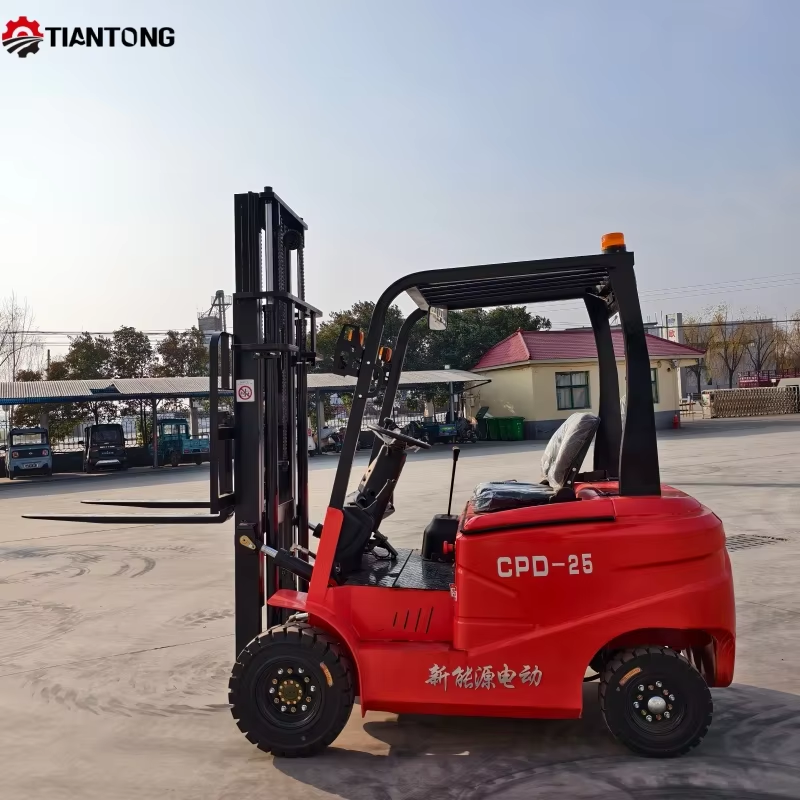
Jining Tiantong Machinery's electric forklift range — including 2-ton and 3-ton four-wheel configurations with customizable lift heights, battery chemistries, and tire specifications — supports duty-cycle-matched specification rather than forcing warehouse operations to adapt to a limited product range.
Cost-Benefit Modeling with Facility-Specific Data
The operational audit data feeds the ROI model: energy cost per hour at the facility's actual utility rate versus current fuel cost per hour, maintenance cost differential based on the facility's existing maintenance spend, battery replacement cost amortized over expected cycle life, and any ancillary savings (reduced ventilation, improved operator productivity from lower noise/vibration). This facility-specific model validates the business case and establishes the post-transition metrics against which success will be measured.
Phase 2: Supplier Evaluation and Selection
Beyond the Spec Sheet: Evaluating Manufacturer Capability
Three evaluation dimensions matter beyond the equipment specification sheet. Manufacturing quality infrastructure: ISO 9001 certification (Tiantong Machinery holds this), CE/UL product certifications, in-house quality testing protocols. Supply reliability: monthly production capacity (2,000 units at Tiantong), on-time delivery performance (99%+ at Tiantong), spare-parts availability and distribution network (150+ service points across 50+ countries). Post-sale support: warranty terms, technical support availability, operator training materials, and maintenance documentation.
A manufacturer's willingness to provide customer references in similar warehouse applications — same industry, similar fleet size, similar duty cycle — indicates confidence in their solution. Ask for references and contact them with specific operational questions rather than general satisfaction queries.
Phase 3: Infrastructure and Training
Execute the infrastructure checklist: electrical service verification, charging station installation, battery management protocol documentation, and PPE procurement (acid-resistant gloves, eye protection, spill kit for lead-acid). Schedule operator training before equipment arrival — covering electric-specific handling, battery charging/watering, and revised pedestrian-safety protocols. Tiantong Machinery provides operator familiarization support with equipment deliveries.
Phase 4: Pilot Deployment
Deploy two to three electric forklifts with selected operators for 30–60 days. Track energy consumption, runtime per charge, operator feedback, maintenance events, and infrastructure issues. Use pilot data to refine the rollout plan — adjust charging-station placement or battery specs before committing the full fleet.
Phase 5: Fleet-Wide Rollout
Execute the transition in 30–50% phases to maintain operational continuity. Retain one or two IC units for outdoor or peak-demand overflow if indicated by the assessment. Establish monthly fleet performance reviews for the first six months, transitioning to quarterly once performance stabilizes.
Real-World Implementation
A Midwest cold-storage operator with 22 diesel forklifts serving -20°C freezers implemented this roadmap over 14 months with Tiantong Machinery electric forklifts. The pilot uncovered that standard lead-acid batteries provided only 3.5 hours of freezer runtime versus the expected 5 hours — the cold-soak effect was more severe than estimated. The data drove a specification change to lithium-iron-phosphate batteries with thermal management for the full fleet, delivering consistent 5.5-hour runtime at -20°C. The pilot-phase adjustment prevented a fleet-wide specification error that would have required costly battery replacement on 22 units.
Frequently Asked Questions
How long does a full warehouse forklift fleet transition take?
A 10–20 forklift fleet transition typically completes in 6–12 months from project approval, including infrastructure preparation (4–8 weeks), pilot deployment (4–8 weeks), and phased fleet rollout (8–16 weeks). Tiantong Machinery's 2,000-unit monthly production capacity supports volume orders without extended lead times.
Should the entire fleet transition to electric at once?
No — a phased approach with a pilot program reduces risk. Transition 2–3 units first, validate performance and infrastructure, then deploy remaining units in 30–50% phases. Retaining one or two internal combustion units for outdoor or overflow work is operationally prudent in many warehouse environments.
What happens to decommissioned internal combustion forklifts?
Three options: trade-in to the electric forklift supplier (some manufacturers accept trade-ins), sale through used-equipment dealers, or retention for limited outdoor/overflow duty. The resale value of well-maintained IC forklifts partially offsets the electric purchase premium.
How should the transition be communicated to warehouse staff?
Communicate the business rationale (operating cost, indoor air quality, noise reduction), the transition timeline, and the training schedule before equipment arrives. Operator involvement in the pilot phase — soliciting feedback, acknowledging the adjustment period — builds buy-in. The near-silent, vibration-free operation typically generates positive word-of-mouth among operators within the first week.
What is the most common unexpected cost in forklift electrification?
Electrical service upgrades — facilities discover during the infrastructure-preparation phase that their electrical panel cannot support the additional charging load. Commissioning an electrical load study during Phase 1 (needs assessment) rather than Phase 3 (infrastructure preparation) prevents this from becoming a schedule-delaying surprise.
Can electric forklifts operate in wet or washdown environments?
Yes — electric forklifts with appropriate IP (Ingress Protection) ratings on motors and electrical connections handle wet conditions. Washdown-rated configurations for food-processing and pharmaceutical environments include sealed electrical connectors, stainless-steel hydraulic components, and corrosion-resistant chassis coatings. Specify washdown requirements during the supplier evaluation phase.