
 EN
EN
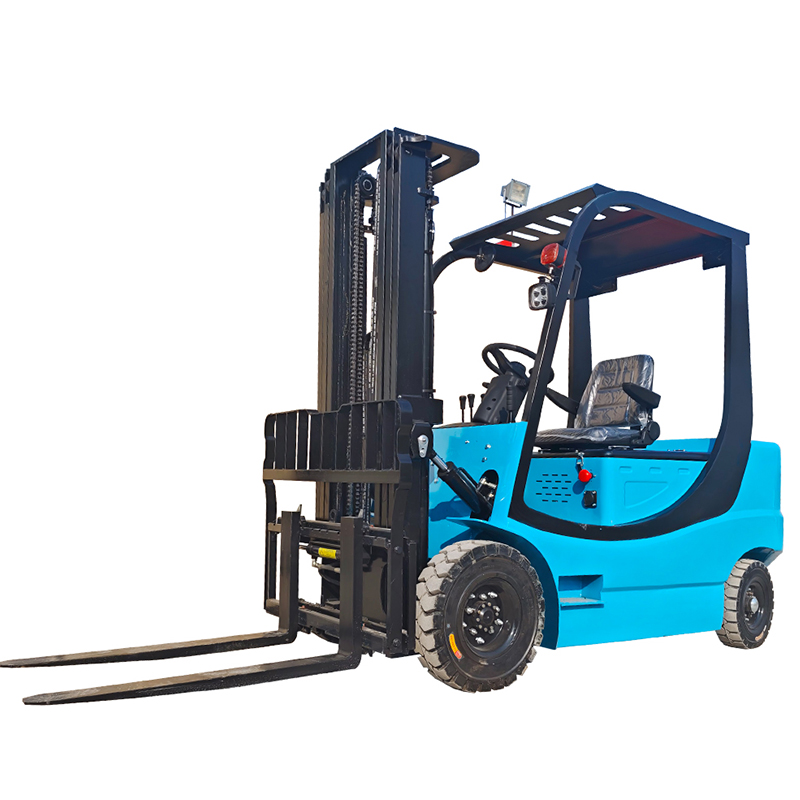
Tight Turns, Clean Air: How Electric Forklifts for Narrow Aisles Solve Warehouse Density Problems
Warehouse real estate costs push operators toward higher-density storage — narrower aisles, taller racking, tighter turning radii. Internal combustion forklifts struggle in these environments: their wider chassis, larger turning circles, exhaust emissions that accumulate in confined aisle spaces, and noise levels that complicate communication in echo-prone rack corridors. Electric forklifts for narrow aisles address each of these constraints through design characteristics that are inherent to electric powertrain architecture, not optional add-ons.
Compact Dimensions and Zero-Turn Capability
How Electric Drivetrain Layout Enables Smaller Chassis Footprints
Internal combustion forklifts package the engine longitudinally behind the operator compartment, adding 300–500mm to overall length compared to an electric model where the battery sits lower and the drive motor mounts directly to the axle. The Tiantong Machinery 2-ton electric forklift measures 2.4m length (excluding forks) and 1.2m width — navigating 2.8–3.0m aisles that would require 3.5m+ aisles for equivalent IC models.
The turning radius compounds the dimensional benefit. Dual AC drive motors achieve 180-degree zero-turn steering — one drive wheel forward, the other reverse — enabling rotation within the forklift's footprint. This transforms aisle-end maneuvers from three-point turns to single-motion rotation. Tiantong's hydraulic power steering and 40mm heavy-duty sprocket shaft enable this capability on 2-ton and 3-ton models.
Mast Height and Overhead Clearance in High-Rack Environments
Narrow-aisle warehouses typically employ high-bay racking reaching 6–12 meters, creating overhead clearance concerns for forklift masts. Electric forklifts offer customizable mast heights — the Tiantong 2-ton model ships with a standard 3-meter lift height configurable to higher specifications — and the mast design (H-type reinforced heavy-duty Laigang steel, 20–30mm thickness on Tiantong models) maintains stability at full extension without the counterweight bulk that internal combustion models require.
The fork dimensions also matter in narrow aisles: 1070 × 120 × 40 mm forged forks on the Tiantong electric model provide adequate length for standard pallet engagement without the excessive fork length that complicates maneuvering in confined rack faces. Fork-length selection should balance pallet-entry clearance against aisle-width consumption.
Emission-Free Operation in Confined Spaces
Why Exhaust Accumulation Is a Narrow-Aisle Health Hazard
Internal combustion forklifts operating in narrow aisles create a ventilation challenge that open-bay warehouses do not face. Exhaust gases — carbon monoxide, nitrogen oxides, particulate matter — accumulate in the confined air volume between rack faces, where natural air circulation is limited. OSHA Permissible Exposure Limits for carbon monoxide (50 ppm over an 8-hour time-weighted average) are routinely approached or exceeded in poorly ventilated narrow-aisle environments with IC forklift operation.
Electric forklifts eliminate this hazard at the source. For cold-storage and food-grade warehouses where exhaust contamination of stored product is a quality concern, electric operation is functionally mandatory. For general warehousing, the ventilation-cost savings from eliminating combustion exhaust represent a secondary ROI stream beyond the energy and maintenance savings discussed previously.
Noise Reduction in Echo-Prone Rack Corridors
Narrow aisles between tall racking create acoustic corridors that amplify and reflect sound. A diesel forklift producing 90 dBA at the source can register 95–100 dBA in the adjacent aisle due to sound reflection between rack faces. Electric forklifts operating at 60–65 dBA reduce aisle noise levels to conversational range — enabling verbal communication between operators and ground personnel without shouting, and reducing long-term hearing-protection requirements. Tiantong Machinery's electric forklift designs specifically address noise reduction through motor-isolation mounting and vibration-damping chassis construction.
Real-World Narrow-Aisle Deployment
A third-party logistics provider specializing in e-commerce fulfillment converted a 60,000-square-foot warehouse from wide-aisle (3.8 meter) to narrow-aisle (2.8 meter) configuration to accommodate 22% additional pallet positions demanded by a major client contract. The conversion required replacing their LP gas forklift fleet — which could not operate safely in 2.8-meter aisles — with Tiantong Machinery 2-ton electric forklifts featuring the 180-degree zero-turn steering capability. The narrow-aisle configuration, enabled by electric forklift dimensions and maneuverability, increased pallet capacity from 8,200 to 10,000 positions within the same building footprint. The client contract that drove the expansion was retained specifically because the facility demonstrated the storage-density increase during the proposal phase.
Frequently Asked Questions
What is the minimum aisle width for a 2-ton electric forklift?
A 2-ton electric forklift with zero-turn steering capability — such as the Tiantong 2-ton model at 2.4m length and 1.2m width — can operate safely in 2.8-meter aisles with standard 1.2m pallets. Add 200mm to the aisle width for each additional 100mm of load overhang beyond the standard pallet dimensions.
Do electric forklifts sacrifice lifting capacity for compact dimensions?
No — the Tiantong 2-ton electric forklift delivers the full 2,000 kg rated capacity at 3-meter lift height within compact dimensions. The reinforced heavy-duty steel chassis and C-section steel 120 frame provide structural strength independent of powertrain type, eliminating the capacity-compactness trade-off.
Can electric forklifts handle outdoor yard operations from narrow-aisle warehouses?
Electric forklifts with solid tires, 15° climbing angle, and weather-resistant electrical components handle limited outdoor operation — moving loads between the warehouse dock and an adjacent yard. Extended outdoor operation in rain or rough terrain requires pneumatic-tire configurations. The Tiantong electric forklift uses 650-10 front and 500-8 rear solid tires suitable for warehouse-to-yard transitions.
How does regenerative braking affect narrow-aisle operation?
Regenerative braking provides precise speed control during slow-speed aisle navigation — releasing the accelerator applies motor braking without the abrupt hydraulic-brake engagement that can shift loads on forks. This precision improves operator confidence during close-tolerance pallet placement at height.
What lighting configurations support narrow-aisle safety?
LED headlights, combination tail/brake/turn signals, and optional blue pedestrian-awareness spotlights projected ahead of and behind the forklift alert ground personnel in narrow aisles where sight lines are limited. The Tiantong 2-ton electric forklift includes LED headlights, left/right turn signals, brake lights, and an electric horn as standard equipment.
Can electric forklifts be configured with side-shift forks for narrow-aisle pallet placement?
Yes — side-shift fork attachments allow lateral fork movement without repositioning the forklift, reducing the number of approach adjustments needed for precise pallet placement in narrow aisles. The attachment adds approximately 100–150 kg to the forklift's load moment, reducing net capacity slightly. Tiantong offers side-shift configuration as an option on electric forklift orders.