
 EN
EN
Two Birds, One Charge: How a Warehouse Electric Forklift Cuts Both Emissions and Operating Cost
A diesel forklift operating an 8-hour shift inside a warehouse emits roughly 12–15 kilograms of CO₂, plus nitrogen oxides (NOx), particulate matter (PM2.5), and carbon monoxide — compounds that accumulate in enclosed spaces and require ventilation systems running at 0.5–1.0 cubic meters per second per forklift to maintain OSHA-compliant air quality. That ventilation system consumes electricity 24 hours a day regardless of how many forklifts are running, adding a hidden energy cost that warehouse operators rarely attribute to their forklift fleet but which disappears entirely when the fleet goes electric.
A warehouse electric forklift produces zero tailpipe emissions — no CO₂, no NOx, no particulates, no carbon monoxide — at the point of use. The electricity that charges its battery may come from a grid that still burns fossil fuels, but three factors make the electric forklift environmentally and economically superior even on a non-renewable grid. First, the power plant generating the electricity converts fuel to energy at 40–55% efficiency, compared to roughly 30% for a small diesel engine — so even "grid-electric" forklifts produce less total CO₂ per unit of work. Second, the electric motor converts over 85% of input energy into mechanical work, versus roughly 30–35% for a diesel engine — meaning less of every energy unit is wasted as heat. Third, as grids decarbonize, the electric forklift automatically becomes cleaner without any equipment change, while the diesel forklift's emissions are locked in for its 10–15-year service life.
The Indoor-Air-Quality Regulatory Landscape
Why Diesel Forklifts Face Growing Restrictions
Regulatory pressure on indoor diesel equipment is tightening globally. OSHA's permissible exposure limit for carbon monoxide is 50 parts per million over an 8-hour time-weighted average — a limit that a single diesel forklift can approach in a poorly ventilated warehouse within 2–3 hours of continuous operation. The European Union's Indoor Air Quality Directive and China's GBZ 2.1 occupational exposure standards impose similar constraints, and insurance underwriters increasingly require electric material-handling equipment in food-processing, pharmaceutical, and cold-storage facilities where combustion byproducts can contaminate products directly.
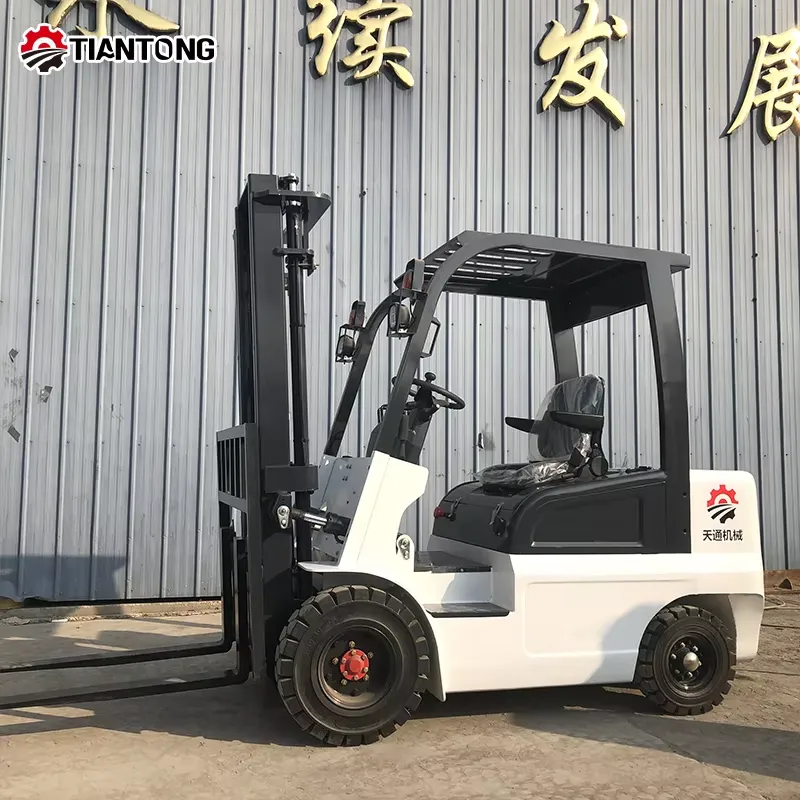
Tiantong Machinery's electric forklifts — ranging from 2-ton units with 4,000W dual AC motors to 3-ton units with 7,500W motors and H-type reinforced masts — address these regulatory requirements at the equipment level. The CE, UL, and RoHS certifications that Tiantong holds confirm compliance with emissions, safety, and hazardous-substance standards that diesel forklifts cannot meet by design. For warehouse operators facing carbon-tax regimes or emissions-reporting requirements, the electric forklift's zero-point-of-use emissions simplify compliance documentation — no fuel-consumption logs, no tailpipe-emissions testing, no ventilation-system upgrades triggered by fleet changes.
Real-World Application: A Food Distributor's Regulatory Trigger
A food-distribution warehouse in Germany received a notification from its occupational safety regulator: indoor CO levels during peak operation exceeded the permissible limit, and the facility had 12 months to comply. The warehouse operated five diesel forklifts across two shifts. The compliance options were: (1) upgrade the ventilation system at an estimated cost of €120,000, or (2) replace the diesel fleet with electric forklifts.
The warehouse chose fleet replacement, purchasing five Tiantong 2-ton electric forklifts with lithium batteries. The total equipment investment was approximately €95,000 — €25,000 less than the ventilation upgrade alone. But the real financial case emerged from operational savings: diesel fuel costs of €32,000 per year dropped to €4,000 in electricity. Diesel-engine maintenance contracts of €9,000 per year dropped to €2,000 for the simpler electric drivetrain. The €35,000 in annual operating savings recovered the equipment investment in under three years — after which the savings continued accumulating for the remainder of the forklifts' 7–10-year service life. The ventilation system was never touched, and CO levels dropped to near zero the day the electric fleet went into service.
Frequently Asked Questions
How much CO₂ does an electric forklift save compared to diesel?
A diesel forklift burning 2.5 L/hour over 2,000 annual operating hours produces approximately 13,000 kg of CO₂ per year (2.5 L × 2.6 kg CO₂/L × 2,000 hours). An electric forklift consuming 5 kWh per shift over 250 operating days totals 1,250 kWh per year — producing roughly 500–600 kg of CO₂ on the average grid, or near zero on a renewable-powered grid. The annual CO₂ reduction per forklift is approximately 12,400 kg — equivalent to taking 2.7 passenger cars off the road.
Do electric forklifts work in cold storage warehouses?
Yes. Lithium batteries maintain over 90% of capacity at -20°C, making them suitable for frozen storage. Diesel forklifts struggle to start in subzero environments and produce emissions that are harder to ventilate from sealed cold-storage spaces. Tiantong Machinery configures electric forklifts for cold-storage applications with appropriate battery sizing and low-temperature-rated hydraulic fluids.
What is the lifespan of a warehouse electric forklift?
With proper maintenance, an electric forklift typically lasts 10–15 years or 15,000–20,000 operating hours in single-shift operation. The battery is the first major replacement item — lithium batteries last 3,000–5,000 cycles (6–10 years in single-shift use), while lead-acid batteries require replacement every 1,200–1,500 cycles (2.5–3 years).
How long does it take to charge an electric forklift?
Standard charging from 20% to 100% takes 6–7 hours on a 220V outlet — suitable for overnight charging between shifts. Opportunity charging (partial charges during operator breaks) is supported on lithium battery systems and can add 30–50% charge in 30–60 minutes. Tiantong's forklifts include auto-shutoff chargers that prevent overcharging.
Are there government incentives for switching to electric forklifts?
Many jurisdictions offer incentives: the U.S. federal Alternative Fuel Vehicle Refueling Property Credit, various state-level zero-emission equipment grants, EU member-state green-logistics subsidies, and accelerated depreciation for electric equipment in several Asian markets. Check local industrial-equipment incentive programs — Tiantong Machinery's sales team can advise on incentive eligibility in specific markets.
What maintenance does an electric forklift need compared to diesel?
Electric forklifts eliminate: engine oil changes (every 250 hours for diesel), fuel filter replacements, air filter replacements, exhaust system maintenance, transmission fluid changes, and coolant system service. Remaining maintenance includes: battery terminal cleaning (monthly), hydraulic fluid checks (weekly), fork and chain inspection (monthly), tire wear monitoring, and brake system inspection. Total maintenance hours per year are typically 60–80% lower than diesel equivalents.